
304 vs 430 Stainless Steel Bench | Which Grade Do You Need?
304 vs 430 stainless steel grade explained for Australian buyers. Understand grades, corrosion resistance and food safety before you buy a bench or benchtop.
BUYING GUIDES: RANGES, GRADES & PRICING
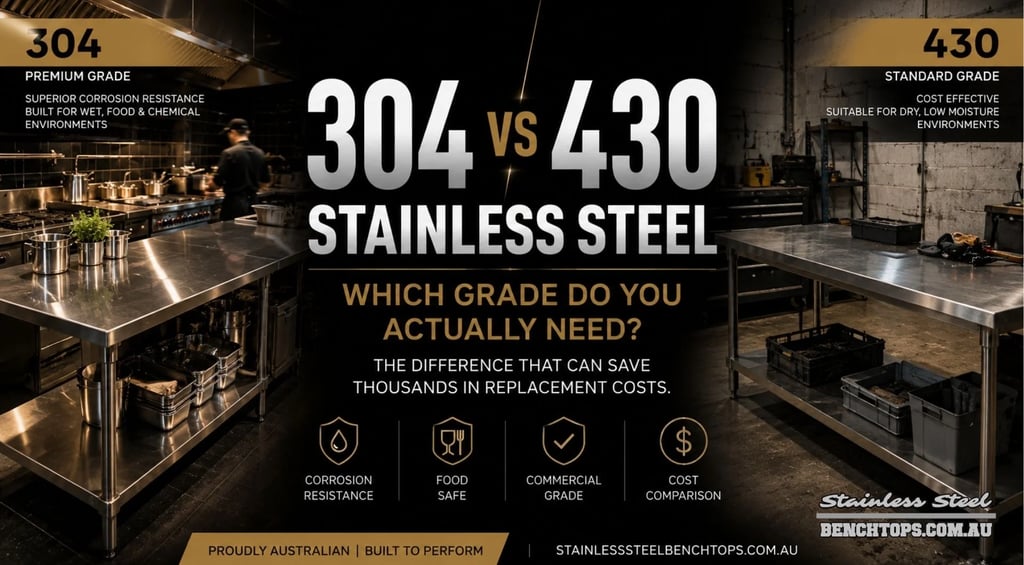
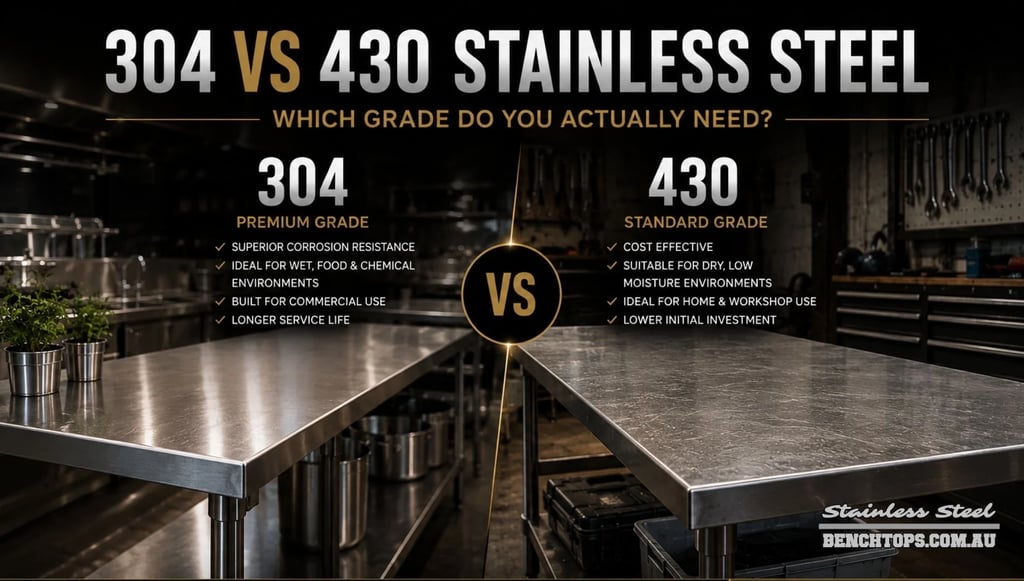
Choose 304 grade stainless steel for wet, food-heavy or frequently washed areas, and 430 grade for dry, low-moisture spaces such as home kitchens, garages and laundries. 304 contains about 8% nickel and resists corrosion better, while 430 has no nickel, costs less and is magnetic.
TL;DR: 304 grade stainless steel contains roughly 18% chromium and 8% nickel, which gives it strong resistance to moisture, food acids and cleaning chemicals, so it suits commercial kitchens, wet areas and heavily cleaned benches. 430 grade has no nickel, is cheaper and is magnetic, and it works well for dry areas and lighter use but is more likely to stain or pit with constant moisture, salt air or chemical cleaners. A magnet sticks to 430 but not to 304, which gives a quick way to check the grade. SSB's Prosumer range comes in 430 (Economy) or 304 (Premium), and the Heavy Duty range uses a 304 benchtop.
Key Takeaways
304 grade stainless steel contains about 18% chromium and 8% nickel, and 430 grade contains about 16 to 18% chromium and no nickel.
304 grade resists moisture, food acids and cleaning chemicals better than 430, so it is the better choice for commercial kitchens and wet areas.
430 grade suits dry, low-moisture spaces such as home kitchens, garages, laundries and craft rooms.
430 grade is magnetic and 304 is not, so a magnet is a quick way to tell them apart.
430 grade costs less because it contains no nickel, and 304 benches usually cost more.
Commercial degreasers, bleach-based sanitisers and chloride cleaners speed up corrosion on 430 grade.
Salt air and constant moisture can cause pitting and tea-staining on 430 grade, so 304 is the safer choice in humid or coastal homes.
Within about 5km of the coast, 316 grade is the recommended minimum, and SSB doesn't stock it.
SSB's Prosumer range is available in 430 (Economy) or 304 (Premium), and its Heavy Duty range has a 304 benchtop.
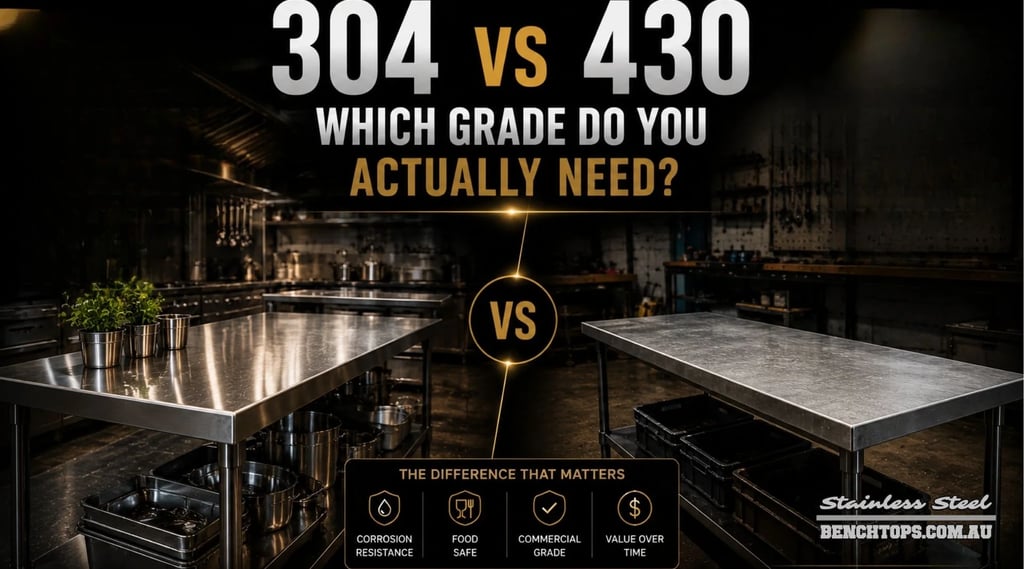
304 vs 430 Stainless Steel: Which Grade Do You Actually Need?
The 304 vs 430 stainless steel debate comes up constantly in commercial kitchens, workshops and home renovation projects across Australia - and most buyers make the decision without fully understanding what the numbers mean. Both grades look identical on a showroom floor. Both are sold as "stainless steel." But in real-world use, particularly anywhere moisture, food or cleaning chemicals are involved, the difference between them is significant enough to determine whether your bench lasts two years or fifteen.
This article explains exactly what separates 304 from 430 grade stainless steel, which environments suit each grade, and how to make the right call for your specific application. Whether you are fitting out a commercial kitchen, upgrading a home prep area or specifying equipment for a food production facility, this guide gives you what you need to decide with confidence.
What Do the Grade Numbers Actually Mean?
Stainless steel grades are not marketing labels - they are standardised compositions defined by the American Iron and Steel Institute (AISI), and they tell you exactly what is in the metal. Understanding the composition is the only way to understand why two benches that look identical behave completely differently in service.
304-grade stainless steel is the most widely used grade in the world. Its standard composition is approximately 18% chromium and 8% nickel - which is why you will sometimes see it referred to as 18/10 stainless steel on cookware, or 18/8 on industrial equipment. The chromium content creates the passive oxide layer that gives stainless steel its corrosion resistance. The nickel content stabilises that layer and dramatically improves resistance to corrosion in the presence of acids, salts and cleaning chemicals. It also improves weldability and makes the steel more ductile.
430-grade stainless steel contains approximately 16 to 18% chromium but no nickel. The absence of nickel reduces the cost of production significantly, which is why 430-grade benches are cheaper to buy. However, without nickel, the passive oxide layer is less stable and more vulnerable to breakdown in the presence of moisture, acid and chloride - all of which are present in any food preparation or cleaning environment. 430-grade is a ferritic steel, meaning it is magnetic and has a slightly different surface finish under certain lighting conditions.
The grade number is not a marketing claim. It is a chemical specification. Ask for it in writing from any supplier.
304 vs 430 Stainless Steel: Side by Side
This table cuts through the marketing language and shows exactly how the two grades compare across the factors that matter in real-world use.
The table makes the trade-off clear. 430-grade saves money at the point of purchase. In any environment where the bench is exposed to food, moisture or chemical cleaning, that saving is recovered and then exceeded by the cost of early replacement and potential compliance failures.
How to Choose the Right Grade for Your Application
The decision between 304 and 430 comes down to one central question: what environment will the bench live in?
Choose 304-grade if any of the following apply:
Your bench will be in a commercial or semi-commercial kitchen. Your bench will be cleaned regularly with chemical sanitisers, degreasers or bleach-based products. Your bench will be used for food preparation, particularly involving acidic ingredients like citrus, vinegar, tomato or raw meat. Your bench will sit in or near a wet zone - next to a sink, under a dishwasher, or in a high-humidity space. Your operation is subject to council health inspections. Your bench will be used outdoors or in a coastal environment where salt air is a factor.
Choose 430-grade if all of the following apply:
Your bench will be in a dry, low-moisture environment. It will not be used for direct food preparation involving acids, meat juices or prolonged moisture exposure. It will be cleaned with standard household products rather than commercial-grade sanitisers. You are setting up a home workspace, garage, laundry or craft room where food safety compliance is not a requirement. Budget is the primary consideration and you understand the trade-off in longevity.
A note on coastal and high-humidity environments:
Even for home use, buyers in coastal Queensland, Northern Territory and humid parts of Western Australia should give serious consideration to 304-grade. Salt air alone is enough to cause pitting on 430-grade stainless steel within a few years, particularly on any bench that sits near an open window or door.
A note on cleaning products:
Standard household multipurpose cleaners are generally safe on 430-grade. Commercial degreasers, bleach-based sanitisers and chloride-containing products - standard in any food business - will accelerate corrosion on 430-grade significantly. If you are running a food business of any kind, 304-grade is not optional, it is the baseline specification.
Stainless Steel Grades in Australian Commercial Kitchens and Food Businesses
In Australia, food safety legislation requires food contact surfaces to be smooth, non-absorbent, non-toxic and easy to clean. 304-grade stainless steel meets all four requirements consistently. 430-grade fails the first requirement over time - once pitting begins, the surface is no longer smooth and becomes a bacterial harbour point that cannot be adequately sanitised.
This is why every serious commercial kitchen equipment supplier in Australia specifies 304-grade for food contact benches, and why council environmental health officers conducting food safety inspections look at the construction and surface condition of benches as part of their assessment.
For restaurant and cafe operators across Brisbane, Sydney, Melbourne, Perth and Adelaide, the Heavy Duty range from SSB uses 304-grade steel throughout, with fully welded seams, 1.2mm gauge tops and adjustable bullet feet as standard. These benches are built to the specification required for a commercial use and are designed to perform in environments where benches are cleaned multiple times per shift, every day of the year.
For food manufacturing and production operations, the specification requirement is even more stringent. Meat processing, seafood handling, bakery production and packaged food lines all require surfaces that can withstand high-frequency chemical washing without degrading. 304-grade handles this. 430-grade does not.
For home cooks and small cafe operators who need more than a home bench but are not running a full commercial operation, the Prosumer range offers 304-grade construction at a more accessible price point - bridging the gap between domestic and commercial specification.
Frequently Asked Questions
What is the difference between 304 and 430 stainless steel for benches?
304-grade stainless steel contains 18% chromium and 8% nickel, giving it excellent corrosion resistance in wet, acidic and chemical environments. 430-grade contains chromium but no nickel, making it cheaper to produce but significantly less resistant to moisture, food acids and cleaning products. In practical terms, a 304-grade bench in a commercial kitchen will last 10 to 15 years. A 430-grade bench in the same environment will begin to pit and corrode within two to four years and will not pass ongoing health inspections.
Is 304-grade stainless steel required for commercial kitchens in Australia?
While Australian food safety legislation does not specify a grade number directly, it requires food contact surfaces to be smooth, non-absorbent, non-toxic and easily cleanable. In practice, 304-grade stainless steel is the only widely available grade that meets all four requirements consistently over the service life of a commercial bench. Environmental health officers conducting food safety inspections regularly flag corroded or pitted bench surfaces as non-compliant, and 430-grade benches in commercial environments are at high risk of reaching that condition within a few years of installation.
Can I use 430-grade stainless steel in a home kitchen?
Yes, for a home kitchen with normal domestic use, 430-grade is a reasonable choice. It handles everyday food prep, standard household cleaning products and low-moisture conditions without significant degradation. Where it starts to fall short is in high-moisture home environments - kitchens with a lot of steam, laundry areas, or coastal homes with salt air exposure. In those situations, spending a little more on a 304-grade bench is worthwhile for the longer service life and better surface integrity over time.
Is 304-grade stainless steel more expensive than 430-grade in Australia?
Yes - 304-grade benches cost more upfront because the nickel content in the steel is more expensive to source and process. The price difference on a standard flat bench typically ranges from $150 to $350 depending on size and configuration. However, when compared across a realistic service life, 304-grade is consistently more economical in any commercial or semi-commercial application. A 430-grade bench that needs replacing in three years costs more over six years than a 304-grade bench purchased once and maintained for twelve.
The Grade Decision Is Not That Complicated
Two grades. One straightforward decision. If your bench will live in a wet, food-heavy or chemically active environment - choose 304. If it is going into a dry, low-contact home workspace - 430 does the job at a lower price.
For anyone running a food business of any kind, or anyone who wants a bench that genuinely lasts, 304-grade is the only specification worth considering. The price difference is recoverable in the first service cycle. The performance difference is not.
SSB supplies 304-grade benches with free metro delivery Australia-wide.
Not sure which configuration suits your setup? Call 0403 741 781 - available 7 days a week - or browse the full range online to compare grades, sizes and configurations side by side.
Get Trade Deals and Clearance Alerts
No spam, just occasional deals, new arrivals, and restock updates.


Unsubscribe anytime.
Buy Now Pay Later
Why Us?
100% Satisfaction Guaranteed On All Orders
Free Metro Delivery
Australian Support
Secure Checkout (Card or PayPal)


© 2026 StainlessSteelBenchtops.com.au. All rights reserved.