
Heavy Duty Stainless Steel Bench | The Industrial Buyer's Guide
Shop SSB's Heavy Duty Stainless Steel workbenches - 304-grade, 1.2mm gauge, fully welded frames. Built for commercial kitchens, workshops & food production.
KITCHENS & SPACES (USE CASES)

Why a Heavy Duty Stainless Steel Workbench ?
If you're shopping for a heavy duty stainless steel workbench, you already know that not every bench on the market is built equally. Some flex under load. Some rust within months. Some look the part but fail the moment a commercial kitchen or workshop puts them to real use. This guide is written for operators, tradespeople, food manufacturers and facility managers who need a workbench that earns its keep every single day - not one that needs replacing in two years.
We'll cover what separates a genuinely heavy duty bench from a light duty imitation, how to read the specs that actually matter, and which configuration suits your environment. By the end, you'll know exactly what to look for before you buy.
A genuine heavy duty stainless steel workbench uses 304-grade steel, has a minimum 1.2mm gauge top, and carries a load rating above 200kg. For commercial kitchens, food manufacturing, workshops and garages, the Heavy Duty Commercial Range (HDCR) is the correct choice. Avoid 430-grade benches for high-demand, corrosive environments - they will not hold up over extended periods of time.
What Actually Makes a Workbench Heavy Duty?
The term "heavy duty" is used loosely by a lot of suppliers. You'll see it on benches that bend under 80kg and rust within six months of sitting near a sink. To cut through the noise, here's what the spec sheet should actually say when you're looking at an industrial stainless bench.
Steel grade. This is the most important factor and the one most buyers overlook. 304-grade stainless steel contains 18% chromium and 8% nickel - the combination that gives it genuine corrosion resistance in wet, acidic and high-temperature environments. 430-grade contains no nickel and significantly less chromium. It handles light use well but degrades faster under commercial-grade daily abuse.
Gauge thickness. Steel gauge measures how thick the sheet metal is. For a heavy duty commercial workbench, the table top should be a minimum of 1.2mm gauge. Thinner tops - 0.8mm or 0.9mm - flex visibly under load and develop stress fractures over time. A 1.2mm gauge bench feels noticeably more solid and holds dimensional accuracy under sustained weight.
Frame construction. The legs and underframe matter as much as the top. Look for fully welded joints, not bolted connections. Bolted frames work loose under vibration. Fully welded frames don't. Square tube legs with cross-bracing - particularly on benches over 1500mm wide - prevent racking and lateral movement when the bench is loaded unevenly.
10mm underlay. The hidden layer that matters most. One of the most significant structural features of the SSB Heavy Duty Premium range - and one that rarely appears in spec sheets - is the 10mm underlay sandwiched between the stainless steel sheet and the frame. This layer is what gives the bench top its notable rigidity and resistance to flex under load. Without it, even a 1.2mm gauge sheet will develop a slight give over time under sustained weight. The underlay eliminates that entirely. It’s the difference between a bench that feels solid and one that merely looks it.
U channel bracing. Why not all ranges have the same amount. U channel bracing runs underneath the bench top and provides critical lateral support, stopping the frame from racking or twisting under load. All SSB ranges include U channel bracing, but the amount differs significantly between tiers. The Heavy Duty Premium range features the most extensive U channel bracing of any SSB bench - more cross members, more coverage, built for environments where the bench is under sustained heavy use every day. The Heavy Duty Economy and Prosumer ranges also include U channel bracing, but with fewer cross members.
The Prosumer and Economy HDCR benches use a single stainless steel sheet with U channel support - reliable for their intended use, but not engineered for the same intensity as the Premium range. If your environment involves constant heavy loading, the Premium range’s additional bracing is worth the step up.
Load rating. A genuine load rated bench will have a specified weight capacity per shelf and overall. For industrial kitchen prep bench use, 200kg distributed load minimum is the starting point. For heavier manufacturing or workshop environments, look for 300kg+ ratings across the top and undershelf combined.
Adjustable bullet feet. Standard on any quality bench. They allow levelling on uneven concrete floors - common in older commercial kitchens, warehouses and workshops - without shimming or wedging.
304 Grade vs 430 Grade: The Comparison That Matters
Most buyers compare prices. The buyers who get it right compare grades first, then prices.
If you are specifying a bench for any application involving food, moisture, cleaning chemicals, or sustained heavy loads, 304-grade is the only correct answer.
How to Choose the Right Heavy Duty Bench for Your Application
Getting the grade right is step one. Getting the configuration right is step two. Here's how to match the bench to the job.
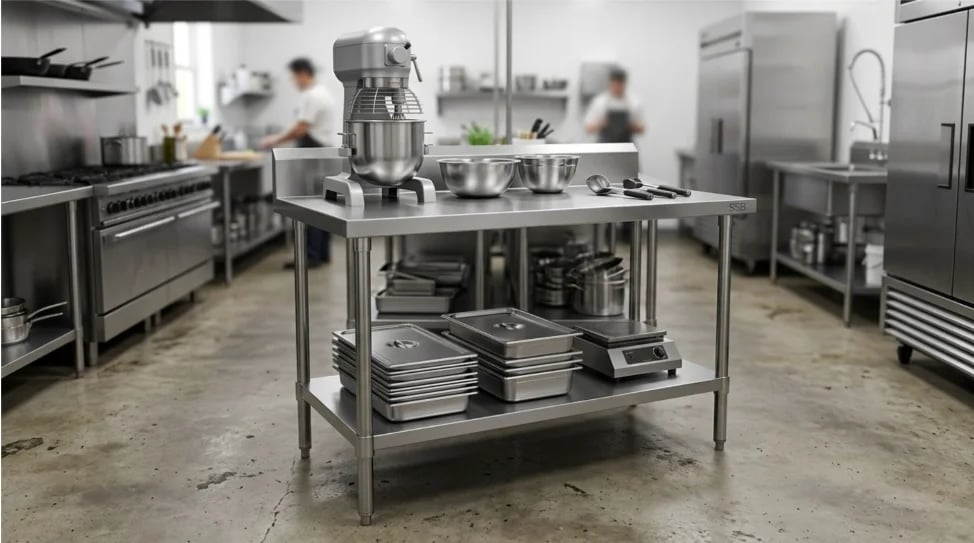
Size and footprint. Measure your available floor space first, then work backwards. Standard depth for a commercial workshop bench or kitchen prep bench is 600mm - enough for comfortable two-handed work without overreach. Width runs from 900mm to 1800mm in standard configurations. For two people working side by side, 1500mm is the minimum comfortable working width.
With or without undershelf. A solid undershelf adds substantial storage for equipment, trays, pots and supplies. A pot rack undershelf (open frame) is easier to clean and allows better airflow in hot kitchen environments. If you're specifying a food factory bench or prep bench in a high-hygiene zone, an open frame undershelf is typically easier to pass a health inspection on - nothing collects underneath it.
Castors vs fixed bullet feet. Fixed bullet feet are the standard for any bench that stays in one position. Castors - including lockable heavy duty castors - suit benches that need to move between stations or be cleared for cleaning. If you're fitting out a workshop or a production floor where layout changes periodically, a stainless bench weight capacity rated castor set makes the bench significantly more versatile.
Overshelves. For kitchen environments where wall space is at a premium, an add-on overshelf mounts directly to the bench top frame and gives you a second working tier for plates, containers, equipment and pass-through items. Single tier overshelves suit most standard kitchen setups. Double tier suits high-volume prep environments.
Splashback. If the bench sits against a wall - especially in a kitchen or food processing environment - a splashback is not optional, it's responsible. It protects the wall from oil, water and food matter and makes end-of-shift cleaning significantly faster. The integrated splashback on HDCR benches is welded directly to the bench top - no gaps, no join, no buildup.
Custom sizes. Standard configurations cover most applications. Where they don't - awkward floor plans, corner installations, specific equipment clearances - custom sizing is the right call. Contact SSB directly with your dimensions before ordering. Custom quotes are available seven days a week.
Who Uses Heavy Duty Stainless Steel Benches in Australia?
The short answer: anyone who needs a bench that genuinely holds up.
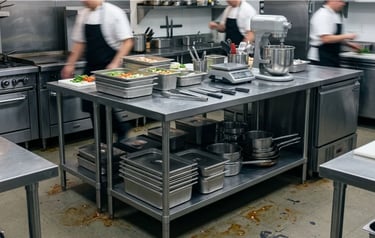
Commercial kitchens. Restaurants, hotels, aged care facilities, school canteens and catering operations generally specify heavy duty 304-grade benches. The combination of food safety compliance, corrosion resistance and daily cleaning durability makes 430 alternatives a false economy. Most commercial kitchen equipment standards in Australia require food contact surfaces to be non-absorbent, smooth and easily cleanable - 304-grade stainless meets all three.
Food manufacturing and processing. Production lines for meat processing, bakeries, confectionery, seafood processing and packaged food manufacture require the same food safe surface as a commercial kitchen, but often with higher load ratings and more demanding cleaning regimes. A 1.2mm gauge bench with welded joints and a solid undershelf rated at 300kg handles this environment comfortably.
Workshops and garages. This is where the Heavy Duty Commercial Range (HDCR) is increasingly chosen over timber or mild steel alternatives. Stainless doesn't rust when oil and coolant splash on it. It doesn't warp when wet. It wipes clean in seconds. For serious home workshops, automotive workshops and trade environments, a load rated HDCR bench with bullet feet on a concrete floor is a 15-year investment that will outlast everything else in the room.
Medical and laboratory environments. Clinics, vet practices, laboratories and dental practices specify stainless for its resistance to chemicals, disinfectants and autoclave environments. The smooth, non-porous surface doesn't harbour bacteria and withstands repeated chemical sanitisation.
Hospitality and events. High-volume catering operations, event caterers and function centres use HDCR benches for off-site prep, service stations and pass-through positions. The combination of durability and easy cleaning makes them the professional standard.
If you're based in Brisbane, Sydney, Melbourne, Perth, Adelaide or Canberra - SSB delivers Australia-wide with free metro delivery on all orders.
Frequently Asked Questions
Q1: What is the best heavy duty stainless steel workbench for a commercial kitchen?
For commercial kitchen use, you need a 304-grade stainless steel workbench with a minimum 1.2mm gauge top and fully welded frame. The Heavy Duty Commercial Range from SSB is specifically built for this environment - food safe, corrosion resistant, and load rated for sustained daily use. Avoid 430-grade options in food environments.
Q2: What load rating should a commercial workshop bench have?
For most commercial kitchen and workshop applications, a minimum distributed load rating of 200kg across the bench top is the standard starting point. For heavier manufacturing or industrial environments, look for benches rated at 300kg or above. Always check both the top rating and the undershelf rating separately - they are often different.
Q3: Is a heavy duty stainless steel bench better than timber for a workshop or garage?
For serious workshop use, yes. Stainless steel does not warp, rust, or absorb oil and chemicals the way timber does. A 304-grade stainless workbench will outlast a timber equivalent by a significant margin in any environment involving moisture, cleaning products or heavy tools. The upfront cost is higher but the total cost of ownership over 10 to 15 years is substantially lower.
Q4: How much does a heavy duty stainless steel workbench cost in Australia?
Heavy duty 304-grade stainless steel workbenches from SSB start from approximately $400 and scale with size, configuration and accessories such as undershelves, overshelves, castors and splashbacks. Custom sizes are available on request with a free quote. Free metro delivery applies across all major Australian capital cities.
Conclusion
Three things determine whether a heavy duty stainless steel workbench is actually worth buying: the steel grade, the gauge thickness, and the frame construction. Get those three right and you have a bench that will serve a commercial kitchen, food factory, workshop or industrial environment for well over a decade without complaint.
The Heavy Duty Commercial Range from SSB is built on all three - 304-grade steel, 1.2mm gauge tops, and fully welded frames with adjustable bullet feet as standard. It's the bench serious operators choose because it handles real work without excuses.
Not sure which size or configuration suits your setup? Visit our FAQ page or contact us directly - we're available seven days a week and happy to recommend the right bench for your specific application.
Get Trade Deals and Clearance Alerts
No spam, just occasional deals, new arrivals, and restock updates.


Unsubscribe anytime.
Buy Now Pay Later
Why Us?
100% Satisfaction Guaranteed On All Orders
Free Metro Delivery
Australian Support
Secure Checkout (Card or PayPal)


© 2026 StainlessSteelBenchtops.com.au. All rights reserved.