
Commercial Stainless Steel Dishwasher Benches Guide | SSB
What to look for in commercial stainless steel dishwasher benches. Inlet, outlet and pass-through configurations explained for Australian commercial kitchens.
KITCHENS & SPACES (USE CASES)
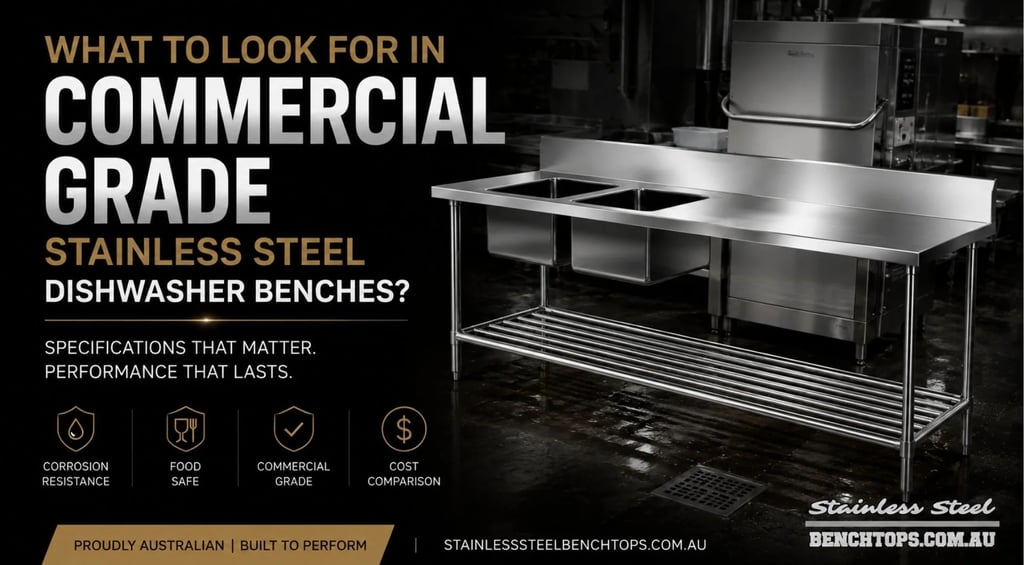
What to Look for in Commercial Grade Stainless Steel Dishwasher Benches
Commercial stainless steel dishwasher benches are among the most functionally demanding pieces of equipment in a professional kitchen - and also among the most under-specified. Most operators pay close attention to the dishwasher itself, then purchase whatever bench fits the space without thinking through how the inlet zone, the machine position and the clean output station work together as a system.
This article is written for restaurant operators, kitchen designers, facility managers and commercial fit-out contractors who need to specify dishwasher bench setups that perform under real service pressure. We cover the key construction specs, the difference between inlet and outlet configurations, what separates a commercial grade bench from a lightweight substitute, and how to match your bench layout to your kitchen's workflow and dishwasher model.
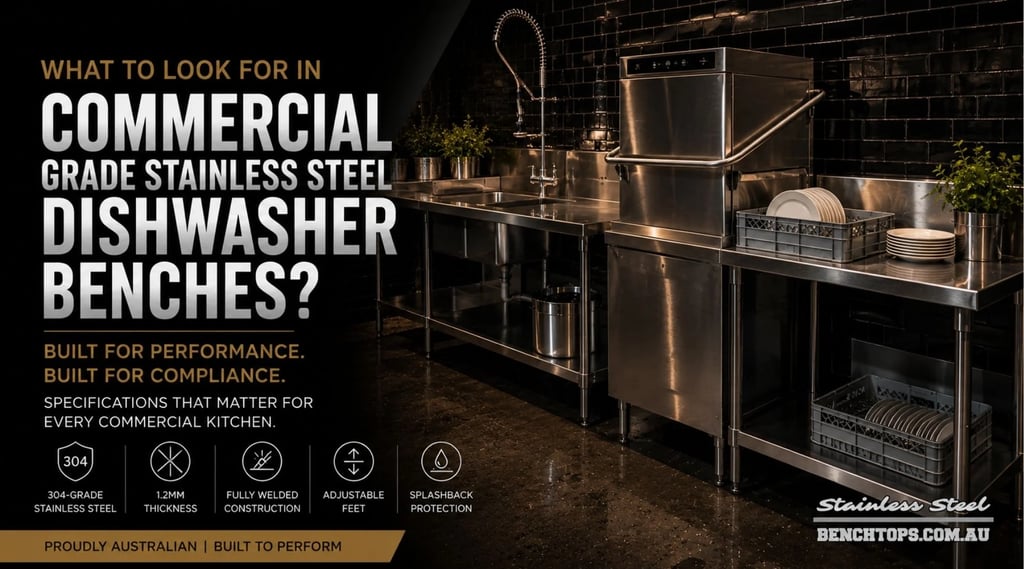
TL;DR - Quick Answer A commercial grade stainless steel dishwasher bench should use 304-grade steel with a minimum 1.2mm gauge top, a fully welded splashback, adjustable bullet feet and the correct left or right configuration to match your machine and kitchen flow. Inlet benches handle the dirty zone. Outlet benches manage the clean side. Pass-through systems handle both. Getting the orientation wrong costs time and creates cross-contamination risk on every single service.
How a Commercial Dishwasher Bench System Actually Works
Most people outside the industry think of a dishwasher bench as just a table next to a machine. In a properly designed commercial kitchen, it is a three-part workflow system with specific functional requirements at each stage.
The dirty intake zone is where soiled crockery, glasses and cookware arrive from the service floor. This section needs to handle heavy stacking loads, food waste accumulation and constant moisture. The inlet bench typically connects to the left or right side of the dishwasher depending on the direction of workflow through the kitchen.
The machine position is where the pass-through dishwasher sits. The bench configuration must account for the machine's footprint, door clearance and drainage requirements. Benches need to be the correct height to align with the machine's entry and exit points - typically 850mm to 860mm for standard commercial dishwashers.
The clean output station is where sanitised items emerge and are sorted before returning to service. This zone needs to be completely separated from the dirty intake side to prevent cross-contamination. A clean dish table with a splashback - to catch steam and moisture from the machine exit - and adequate surface area for stacking and sorting is the functional requirement here.
Getting all three zones right - the right bench configuration, the right orientation and the right construction spec - determines how efficiently your dishwashing operation runs across every service. It also determines whether your kitchen passes food safety inspections consistently.
Inlet vs Outlet vs Pass-Through: Choosing the Right Configuration
The most common specification mistake on dishwasher bench projects is ordering the wrong orientation. Left and right are not interchangeable - they refer to the position of the sink bowl or machine connection relative to the operator facing the bench. Getting this wrong means a bench that physically does not work in your layout.
Left vs right - how to determine which you need:
Stand at the position where your dishwasher will sit and face the machine. The side from which soiled items will approach is your inlet side. The side from which clean items will exit is your outlet side. Your inlet bench matches that approach side. Your outlet bench matches the exit side. If items flow from left to right through your kitchen, your inlet is on the left and your outlet is on the right.
What Separates a Commercial Grade Dishwasher Bench from a Standard Bench
Not every stainless steel bench is suitable for a dishwasher station. The environment around a commercial pass-through dishwasher is one of the most demanding in any kitchen - constant steam, high humidity, chemical sanitiser residue and heavy daily loading. Here is exactly what to look for in the specification.
304-grade steel throughout
Not every stainless steel bench is suitable for a dishwasher station. The environment around a commercial pass-through dishwasher is one of the most demanding in any kitchen - constant steam, high humidity, chemical sanitiser residue and heavy daily loading. Here is exactly what to look for in the specification.
1.2mm gauge top as a minimum
Dishwasher inlet benches carry significant point loads from stacked plates, cookware and glass racks. A 0.9mm gauge top will develop surface flex and stress fractures under this load over time. The 1.2mm gauge top maintains dimensional stability and surface integrity under sustained commercial loading.
Fully welded splashback - 150mm
The splashback on a dishwasher bench is not decorative. It catches the steam and moisture that exits the machine during the wash cycle and prevents wall damage, mould growth and cross-contamination. A 150mm splashback suits standard setups. A 150mm splashback is recommended on double sink inlet benches and high-volume operations where steam output is greater. The splashback must be fully welded to the bench top - any bolted or clamped join is a bacterial accumulation point that cannot be properly sanitised.
Adjustable bullet feet
Commercial kitchen floors are rarely perfectly level, and dishwasher areas in particular are often subject to drainage gradients. Adjustable bullet feet allow fine levelling without shimming, and they raise the bench frame off the floor to allow proper cleaning underneath - which is an inspection requirement in most Australian council jurisdictions.
For operations that require a permanently fixed bench position, bolt-down feet are available as an optional replacement for the standard bullet feet. These anchor the bench directly to the floor, eliminating any movement during heavy use or in high-traffic areas where bench stability is critical. If your kitchen layout is finalised and the dishwasher station will never need repositioning, bolt-down feet are worth specifying from the outset.
Reinforced undershelf
A solid undershelf beneath a dishwasher bench provides storage for spare glass racks, detergent supplies and cleaning equipment. It also adds structural rigidity to the bench under the point loads of heavy plate stacks. Open pot rack undershelves are easier to clean in this environment and preferred in high-humidity zones.
Commercial Dishwasher Bench Applications Across Australian Food Businesses
Pass-through dishwasher inlet and outlet benches are standard specification in commercial kitchens across Australia - from high-volume restaurant groups in Melbourne and Sydney to aged care facility kitchens in regional Queensland and catering operations in Perth and Adelaide.
High-volume restaurants and hotels typically run a full modular system: a left or right inlet bench with pre-rinse sink, a pass-through machine, and a clean dish table on the exit side. The clean dish table with a 150mm splashback handles the steam output from the machine and provides adequate surface area for sorting and restacking before items return to service. SSB's modular clean dish table is designed specifically for this configuration.
Aged care and institutional kitchens specify dishwasher bench systems that meet hygiene standards under the Food Standards Code and are easy for staff to sanitise at the end of each shift. Fully welded construction with no exposed joins is the key requirement. The fully welded splashback on SSB's heavy duty dishwasher benches meets this standard directly.
Catering and events operations using pass-through dishwashers in temporary or semi-permanent setups need benches that can be repositioned without losing function. Benches with adjustable bullet feet handle uneven flooring in event venues and temporary kitchen setups without requiring shimming or levelling work.
Food manufacturing facilities with dedicated washing stations for equipment and processing trays specify heavy duty dishwasher benches with high load ratings and pot rack undershelves for easier cleaning between production runs.
Browse the full range of stainless steel pass-through dishwasher inlet and outlet benches.
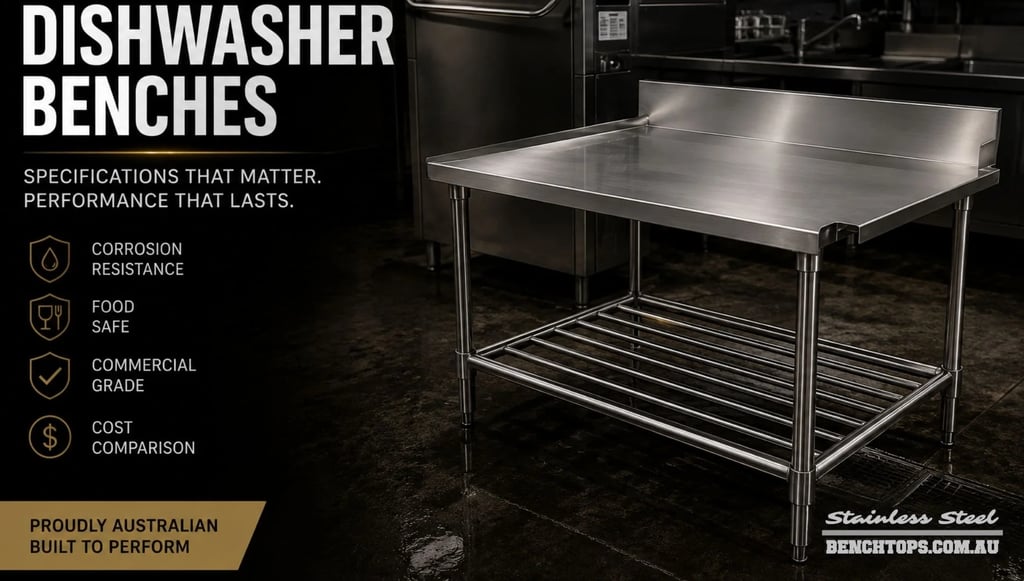
Frequently Asked Questions
What should I look for in a commercial stainless steel dishwasher bench?
The four key specifications are: 304-grade steel throughout, a minimum 1.2mm gauge top, a fully welded splashback of 150mm, and adjustable bullet feet. These features ensure the bench handles the steam, chemical exposure, moisture and heavy loading of a commercial dishwashing station without degrading or creating food safety compliance issues. Avoid benches with bolted joins on the splashback - they cannot be adequately sanitised and will fail health inspections over time.
What is the difference between a left and right inlet dishwasher bench in a commercial kitchen?
Left and right refer to the position of the sink bowl relative to the operator facing the bench. A left inlet bench has the sink positioned on the left, meaning soiled items approach from the left and feed into a dishwasher on the right. A right inlet bench is the mirror configuration. Determining which you need requires mapping your kitchen's workflow direction before ordering - the inlet side is always the side from which dirty items approach the machine.
Can I use a standard stainless steel bench next to a commercial dishwasher instead of a dedicated dishwasher bench?
Technically yes, but it is not recommended for a permanent commercial installation. A standard flat bench lacks correctly positioned splashback height and specific surface layout that a dishwasher station requires for efficient operation. The time cost of workarounds - manual scraping, repositioning items, managing steam without an adequate splashback - adds up significantly across a busy service. For a licensed food business, a dedicated dishwasher bench is the correct specification.
How much do commercial stainless steel dishwasher benches cost in Australia?
Heavy duty 304-grade dishwasher benches from SSB range from approximately $400 for standard outlet benches to over $1,200 for double sink inlet configurations with 180mm splashbacks. Modular clean dish tables and full pass-through system setups vary based on size and configuration. Free metro delivery applies across all major Australian capital cities. For custom sizing or specific machine clearance requirements, contact SSB directly on 0403 741 781 for a free quote.
Specify It Right Before You Order
Three decisions determine whether your commercial dishwasher bench system works properly: the orientation - left or right - the construction spec - 304-grade, 1.2mm gauge, fully welded splashback - and the configuration - inlet, outlet or full pass-through. Get all three right and your dish zone runs cleanly and efficiently through every service. Get any one of them wrong and you are working around the problem every shift.
SSB supplies heavy duty 304-grade dishwasher benches across Brisbane, Sydney, Melbourne, Perth, Adelaide and Canberra with free metro delivery on all orders.
Not sure which orientation or configuration suits your kitchen layout? Call 0403 741 781 - available 7 days a week - or contact SSB online for a free recommendation before you order.
Get Trade Deals and Clearance Alerts
No spam, just occasional deals, new arrivals, and restock updates.


Unsubscribe anytime.
Buy Now Pay Later
Why Us?
100% Satisfaction Guaranteed On All Orders
Free Metro Delivery
Australian Support
Secure Checkout (Card or PayPal)


© 2026 StainlessSteelBenchtops.com.au. All rights reserved.