
Stainless Steel Folding Table | Sizes, Uses and Buying Guide
Not sure which stainless steel folding table suits your setup? We compare grades, sizes and best uses for catering, market stalls and commercial food prep.
SIZING & CONFIGURATION
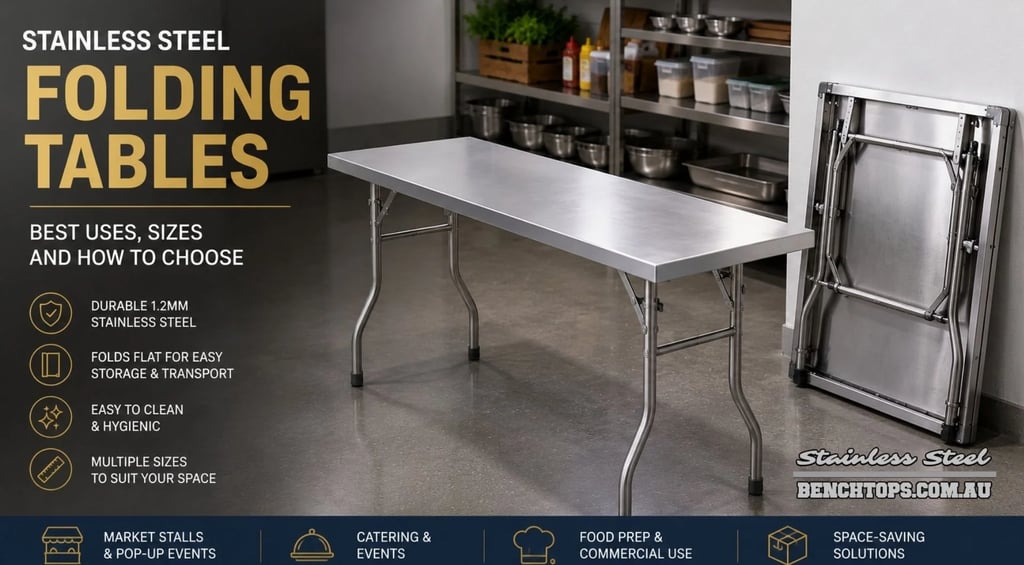
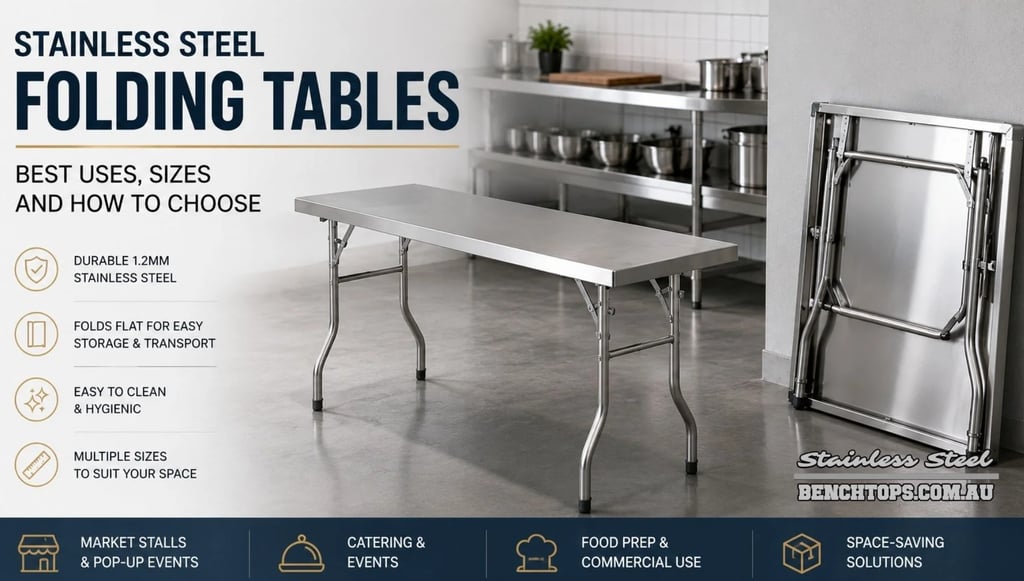
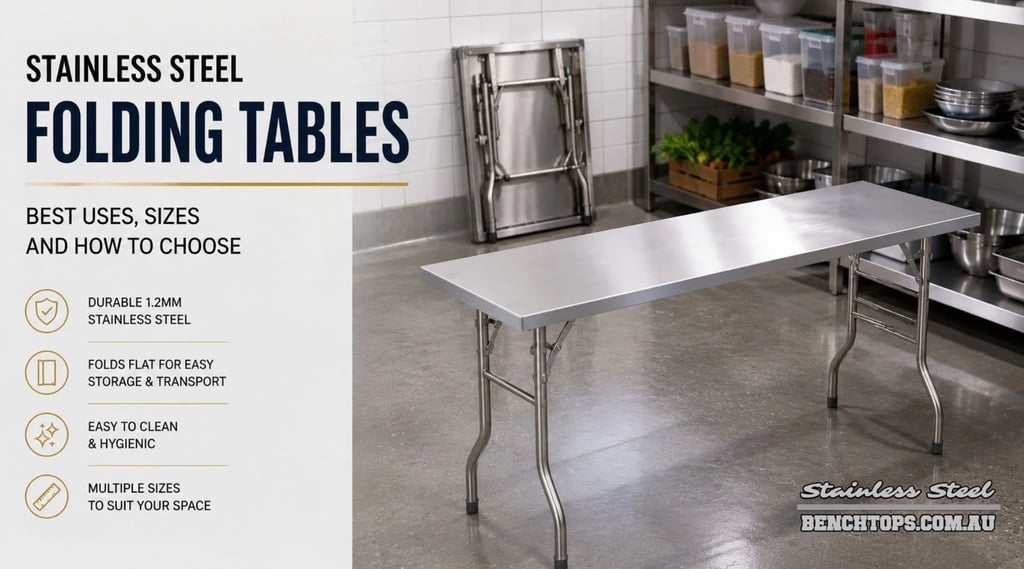
Stainless Steel Folding Tables: Best Uses, Sizes and How to Choose
A stainless steel folding table solves a specific problem: you need a hygienic, food-safe prep surface that doesn't take up permanent floor space. For market stall operators, caterers running pop-up events, small food businesses with shared kitchen access, and commercial kitchens that need flexible overflow prep space, a fixed bench isn't always the right answer - and a plastic trestle table certainly isn't.
This guide is written for anyone comparing stainless steel folding tables for catering, food prep or commercial use. We'll cover what separates a folding stainless bench from a fixed one, how grade and size affect what the table is actually suited to, how to match the right specification to your situation, and the questions worth asking before you order.
TL;DR - Quick Answer
Stainless steel folding tables in our Prosumer range come in 430-grade Economy (suited to dry prep and catering) and 304-grade Premium (suited to wet prep and more demanding food applications), in standard lengths from 1200mm to 1800mm with a 600mm standard depth and 1.2mm gauge top. The folding leg mechanism makes them genuinely portable and space-saving - the trade-off versus a fixed bench is that a folding frame is inherently less rigid than a fully welded structure, so they're best matched to the load profiles they're designed for rather than used as a substitute for a permanent heavy-duty bench.
What Makes a Stainless Steel Folding Table Different from a Fixed Bench
The obvious answer is portability, but the more useful answer is what that portability costs you in terms of structure - and what it doesn't.
A fixed stainless bench gets its rigidity from a fully welded frame with cross-bracing and an undershelf or leg brace that ties the legs together and stabilises the whole structure. A folding table trades that fixed structure for a collapsible leg mechanism that lets the table fold flat for storage and transport. That mechanism introduces a different kind of structural behaviour: the legs fold rather than weld, which means the rigidity of the assembled table depends on how well the folding joints lock and how the load is distributed across the top.
For the use cases a folding table is designed for - catering events, market stalls, pop-up food prep, overflow prep in a kitchen that needs the floor space back after service - this is a sensible trade-off. You're not running a 10-hour commercial kitchen service on a folding table. You're setting up for a market, breaking down after an event, or using the table for prep that a fixed bench doesn't need to handle.
Where the difference matters is when buyers try to use a portable stainless steel table as a direct substitute for a permanent bench in a high-load, sustained-use environment. A folding table at 1.2mm gauge will handle reasonable prep loads - pots, trays, food containers, light equipment - without issue. It's not the right tool for heavy point-loading, sustained wet-zone use, or situations where you'd otherwise be specifying a Heavy Duty Commercial bench. Matching the tool to the task is the core of getting this decision right.
The other practical difference is setup and storage. A foldable stainless bench typically sets up in under two minutes and collapses flat enough to store vertically against a wall or in the back of a van. For operators who set up and break down regularly, this is a meaningful operational advantage over any fixed bench, regardless of material.
Folding Table Comparison: 430-Grade Economy vs 304-Grade Premium
Both options in the Prosumer range share the same 1.2mm gauge top and standard sizing. The difference is steel grade, which determines corrosion resistance, chemical tolerance and how long the table holds up under the specific conditions of your use.
How to Choose the Right Stainless Steel Folding Table
The right folding table comes down to four questions answered honestly, in order.
First: what are you actually going to do on it? Dry food handling - slicing, packing, plating, assembling - suits the 430-grade Economy table well and doesn't justify the step up in cost to 304-grade. Wet prep - working with marinades, proteins, wet produce, or anything that involves standing liquid on the surface - warrants the 304-grade Premium. The difference isn't academic: 430-grade without nickel is more vulnerable to surface staining and corrosion when wet food matter sits on it for extended periods, and for a catering operator who's sanitising the table repeatedly between uses, the 304 surface holds up better over the life of the table.
Second: what size suits your setup? Our folding tables come in standard lengths - 1200mm, 1500mm and 1800mm - at a standard 600mm depth. A 1200mm table is compact and easy to transport, well suited to a market stall or a tight event setup. A 1500mm table gives a single operator meaningful working room for prep and service side by side. An 1800mm table is the right call where two people are working the bench simultaneously or where you need to lay out a full catering spread. The sizing rule that applies to fixed benches applies here too: go as large as your transport and setup space allows, not as small as you think you can manage.
Third: how often are you setting it up and breaking it down? A table that goes out every weekend to a farmers market has a very different wear profile to one that gets used twice a year for a catering event. Frequent setups mean the folding leg mechanism gets more cycles, and it's worth checking that the locking joints feel solid when assembled - a slight flex at the joint when the table is loaded is worth noting before you're committed to it in a professional setting.
Fourth: where is it being stored? A folding table that stores flat takes up roughly the footprint of the tabletop and almost no depth. For operators with limited storage - a shared commercial kitchen, a small catering operation running out of a domestic space, a van or trailer - this genuinely changes the economics versus a fixed bench that has to stay where it's put.
Where Stainless Steel Folding Tables Work Hardest in Australia
The use cases where we see foldable stainless benches doing their best work are consistent across the country, whether the operator is in Brisbane, Sydney, Melbourne or Perth.
Market stalls and pop-up food businesses are the primary use case. A stainless folding table sets up fast, breaks down clean, and gives a food stall the kind of professional, hygienic prep surface that plastic trestles simply don't. For operators who need to pass council food handling inspections at market venues, a stainless surface is a significantly easier conversation with an inspector than a plastic or timber alternative. The Prosumer range covers both the Economy and Premium options for this application.
Catering and event companies use folding stainless benches as portable prep and service surfaces at functions, venue setups and private events. The collapsible prep table goes in the van, sets up at the venue and comes home clean. For catering operators handling raw proteins or working with wet ingredients on-site, the 304-grade Premium is the correct specification - it handles the repeated sanitising between functions that 430-grade isn't built for.
Commercial kitchens needing overflow prep space use folding tables as temporary workstations during high-volume service periods. The table goes up when it's needed and comes down when floor space has to be recovered. This is also where the space-saving prep table concept makes the most sense in a licensed kitchen: the fixed benches do the heavy lifting for daily operations, and the folding table handles surge demand without permanently reducing the kitchen's working footprint.
Small food businesses and home caterers setting up in shared commercial kitchen spaces benefit from a folding table they can bring in and take out with their kit, rather than relying on whatever prep space the shared facility provides.
The Right Folding Table for the Right Job
A stainless steel folding table is a tool with a specific job: portable, hygienic, food-safe prep and service in settings where a fixed bench either can't go or doesn't need to stay. Get the grade right for your use (430-grade Economy for dry applications, 304-grade Premium for wet prep and repeated sanitising), size up rather than down within your transport and setup constraints, and don't ask a folding table to do the job of a permanent Heavy Duty Commercial bench.
Browse the Prosumer range to compare folding table sizes and grades, or see the full range of stainless steel equipment if you're also specifying fixed benches alongside a portable option. For any questions about which size or grade suits your setup, call 0403 741 781 - seven days a week - for a straight answer.
Frequently Asked Questions
What is the best stainless steel folding table for catering use in Australia?
For catering involving wet ingredients, raw proteins or repeated on-site sanitising, the Prosumer Premium 304-grade folding table is the right specification - it handles repeated chemical cleaning and wet food contact better than the 430-grade Economy option. For dry catering applications - assembling platters, packing dry goods, service prep - the Prosumer Economy 430-grade table does the job at a lower price point. Both come in 1200mm, 1500mm and 1800mm lengths at 600mm standard depth and 1.2mm gauge.
Can a folding stainless bench be used as a permanent prep bench in a commercial kitchen?
It can, but it's not what a folding table is designed for and there are trade-offs worth understanding. A folding leg mechanism is inherently less rigid than the fully welded frame of a fixed Prosumer or Heavy Duty Commercial bench, and for high-load, sustained or wet-zone use, a fixed bench is the better specification. Where a folding bench works well as a semi-permanent addition is in lower-load roles - a secondary prep station, a packaging bench, a pass bench during service - where the flexibility of being able to fold it away is operationally useful and the load profile doesn't demand a fixed frame.
How quickly does a sealed timber bench become a compliance problem in a working kitchen?
It depends heavily on how the kitchen operates, but most commercial kitchens put timber sealant under significant stress: high-temperature cleaning products, steam, acidic food matter and daily scrubbing all work against the surface. In a high-volume kitchen with daily sanitising, visible sealant wear can start appearing within 12 to 18 months, and once the seal goes, so does the smooth, impervious surface the standard requires. In a lower-volume or drier environment - a bakery with minimal wet contact, for example - sealed timber can last longer. The risk is that the degradation is gradual and easy to overlook until an inspection makes it a formal issue.
Is a 430-grade folding table good enough, or should I always choose 304-grade?
It depends entirely on what the table will be used for. The 430-grade Economy folding table is a genuinely capable product for dry food handling, market stall prep, event setup and any application where the surface isn't regularly exposed to wet ingredients, acidic food matter or harsh sanitisers. If those conditions apply to your use - wet prep, regular chemical cleaning, humid storage conditions - the 304-grade Premium is worth the additional cost. The grade decision follows the use case, not a blanket hierarchy.
How much does a stainless steel folding table cost in Australia, and what affects the price?
Prosumer folding tables are priced within the Prosumer range, which starts from around $190 and scales with length and grade - a 1200mm Economy table sits at the lower end, and an 1800mm Premium 304-grade table sits toward the upper end of the Prosumer range. Free metro delivery applies across Brisbane, Sydney, Melbourne, Perth, Adelaide and Canberra. If you need a size or configuration outside the standard range, a custom quote is available - call 0403 741 781 seven days a week.
One point worth being clear on: neither option is a marine-grade product. Our 304-grade Premium is the highest grade we stock, and it suits most indoor commercial food applications very well. For premises within about 5km of the coast, 316 is the ASSDA-recommended grade for outdoor or exposed environments - it's not something we currently stock, so if that's your situation, it's worth confirming the right specification with your local Food Inspection Authority before ordering.
Get Trade Deals and Clearance Alerts
No spam, just occasional deals, new arrivals, and restock updates.


Unsubscribe anytime.
Buy Now Pay Later
Why Us?
100% Satisfaction Guaranteed On All Orders
Free Metro Delivery
Australian Support
Secure Checkout (Card or PayPal)


© 2026 StainlessSteelBenchtops.com.au. All rights reserved.