
Stainless Steel vs Timber Benchtops | Commercial Kitchen
Stainless steel or timber for your commercial kitchen? We compare hygiene, FSANZ compliance, durability and cost to help you choose the right bench material.
BUYING GUIDES: RANGES, GRADES & PRICING
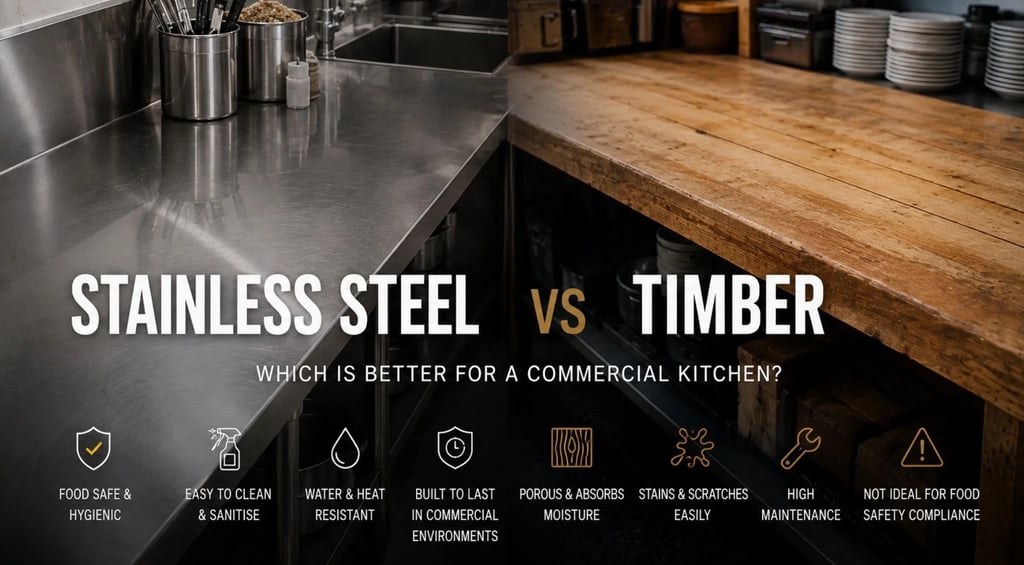
Stainless Steel vs Timber Benchtops: Which Is Better for a Commercial Kitchen?
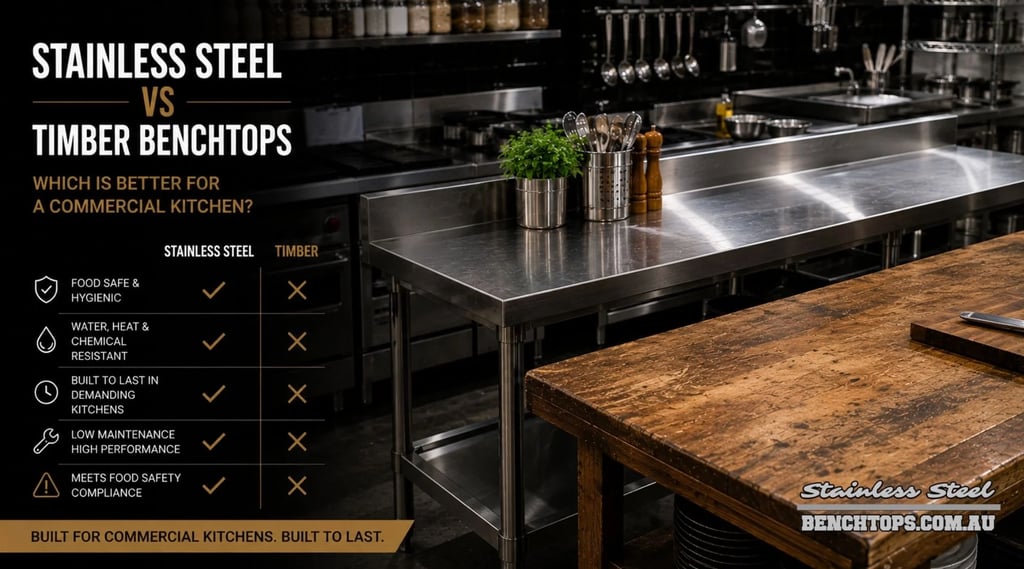
The stainless steel vs timber benchtop debate looks like a cost question on the surface, but in a commercial kitchen it's really a hygiene and compliance question first. Australian food safety regulations require food contact surfaces to be smooth, non-porous and easy to clean - criteria that stainless steel meets by design and timber doesn't, which is why stainless has been the default commercial kitchen bench material for decades.
This article is written for hospitality operators, commercial kitchen designers and anyone setting up a food business who wants a straight comparison rather than a sales pitch. We'll cover why the material choice matters for food safety, how the two perform side by side across every factor that counts in a working kitchen, how to read your own situation honestly, and what to look for when specifying the right stainless bench for your setup.
TL;DR - Quick Answer
Timber isn't banned outright under FSANZ Standard 3.2.3 - but the standard requires food contact surfaces to be smooth, impervious and easy to clean and sanitise, and timber becomes increasingly difficult to keep compliant as sealants degrade under repeated commercial use. Stainless steel holds up to that standard without the maintenance burden, which is why it's the practical industry choice for commercial kitchens. The honest case for stainless isn't that timber is illegal - it's that timber is much harder to keep compliant over time.
Why Bench Material Matters More in a Commercial Kitchen Than at Home
In a home kitchen, a timber benchtop is a reasonable lifestyle choice. You control what goes on it, how often it's cleaned, and how it's maintained. If it needs resanding and resealing every few years, that's a manageable trade-off for the aesthetic.
A commercial kitchen operates under a different set of rules entirely. The FSANZ Food Standards Code, which governs food premises and equipment across Australia, requires food contact surfaces and benches to be smooth, impervious to moisture, free from cracks or crevices that can harbour bacteria, and able to withstand repeated cleaning and sanitising without breaking down. These aren't suggested guidelines - they're the basis on which council environmental health officers inspect and license food premises. A bench material that absorbs moisture and can't be fully sanitised isn't just a hygiene concern, it's a compliance risk.
This is where timber and stainless steel diverge in practice. Timber is a porous material by nature, and even properly sealed timber relies on that sealant remaining intact to meet the smooth, impervious standard FSANZ requires. In a high-volume commercial kitchen, that sealant degrades faster than most operators plan for - repeated sanitising, heat, moisture and the general wear of service all break it down, and once it goes, moisture and food matter work into the grain and the surface becomes genuinely difficult to clean to a compliant standard. Stainless steel has no sealant layer to degrade. The surface itself is the protection, which is why it holds up to repeated sanitising without its hygiene properties changing over time.
How to Choose the Right Stainless Bench for Your Food Business
Once the material question is settled, the real decision is which specification of stainless bench suits your kitchen. Not every commercial food operation needs the same setup, and over-specifying is nearly as common a mistake as under-specifying.
Start with the environment, not the price
A dry-use prep area with low moisture exposure has different requirements to a bench positioned next to a commercial sink or dishwasher, or one used directly under a steam oven. The wetter and more chemical-heavy the environment, the more the HDCR 304-grade specification earns its place over the Prosumer range.
Match the grade to your actual use
Our Prosumer Premium 304-grade bench is a genuinely capable bench for a food business with moderate use - a small cafe, a bakery prep area, a catering prep bench that gets sanitised daily but isn't positioned in a constant splash zone. The Heavy Duty Commercial Range is where we'd point a full-service restaurant, a high-volume commercial kitchen, or any bench that needs to handle constant wet contact, repeated sanitising and sustained heavy loading across a long service life. To be clear about what "our best" means here: within our range, the HDCR 304-grade is the highest quality option we offer, built specifically for the demands of commercial food preparation.
Think about configuration as part of the hygiene setup
A splashback bench keeps moisture and food debris off the wall behind it, which is its own hygiene benefit in a licensed kitchen - the wall doesn't become a secondary cleaning problem. An undershelf with a solid surface is easier to keep compliant than an open frame, since it provides a cleanable surface under the bench rather than a dust and debris trap. And if your council inspector is checking floor clearance - common in commercial kitchen assessments - adjustable bullet feet that lift the bench off the floor and allow cleaning underneath aren't optional, they're the kind of detail that gets noted on an inspection report.
Stainless Steel Benches in Australian Commercial Kitchens
We supply Prosumer and Heavy Duty Commercial benches to food businesses across Brisbane, Sydney, Melbourne, Perth, Adelaide and Canberra, with free metro delivery and same-day pickup available from our Coopers Plains depot in Brisbane.
The majority of our commercial kitchen customers come to us at one of two points: setting up a new premises and specifying correctly from the start, or replacing timber or inadequate benchtops after a council inspection flags a compliance issue. The second scenario is consistently more expensive than the first, because it involves urgency, potential reinspection costs and disruption to a trading kitchen. Getting the bench material right at the setup stage is almost always the lower-cost path.
For a full-service commercial kitchen, the Heavy Duty Commercial Range covers the standard configurations - flat prep benches, splashback benches, sink benches, undershelf and overshelf setups, and custom-quoted sizes for non-standard spaces. For a smaller food business, a market stall or a catering prep kitchen that operates in a controlled environment, the Prosumer Premium 304-grade range is worth reviewing as a more cost-accessible starting point that doesn't compromise on food safety compliance.
If you're setting up in a coastal area or near the ocean, it's worth a separate conversation - 304-grade is our standard commercial specification and suits most indoor kitchens, but for premises within about 5km of the coast, we'd recommend confirming the right specification with your local Food Inspection Authority before ordering, since 316 is the ASSDA-recommended grade for those environments and it's not something we currently stock.
Frequently Asked Questions
Does FSANZ actually ban timber benchtops in commercial kitchens?
Not by name. FSANZ Standard 3.2.3 requires food contact surfaces to be smooth, impervious, and able to be effectively cleaned and sanitised - it specifies a performance standard, not a materials list. Properly sealed timber can technically meet that standard in some applications. The practical problem is that commercial sanitising, heat, moisture and daily wear degrade timber sealants faster than most operators expect, and a surface that was compliant when sealed becomes progressively harder to keep that way. Stainless steel doesn't have that problem - the surface itself is what meets the standard, with no sealant required and no degradation from repeated cleaning.
Can I use a timber cutting board on a stainless steel bench?
Yes - and this is actually a good example of where timber has a legitimate place in a commercial kitchen. A removable timber or polyethylene chopping board is a controlled, replaceable food contact surface that can be inspected, sanitised or replaced separately. That's very different to a fixed timber benchtop where the entire surface needs to maintain compliance. Using a quality stainless prep bench as the base and a dedicated cutting board on top for knife work is exactly the kind of setup most commercial kitchens run - you get the hygienic, impervious bench underneath and a purpose-built cutting surface on top.
How quickly does a sealed timber bench become a compliance problem in a working kitchen?
It depends heavily on how the kitchen operates, but most commercial kitchens put timber sealant under significant stress: high-temperature cleaning products, steam, acidic food matter and daily scrubbing all work against the surface. In a high-volume kitchen with daily sanitising, visible sealant wear can start appearing within 12 to 18 months, and once the seal goes, so does the smooth, impervious surface the standard requires. In a lower-volume or drier environment - a bakery with minimal wet contact, for example - sealed timber can last longer. The risk is that the degradation is gradual and easy to overlook until an inspection makes it a formal issue.
How much does a commercial stainless steel bench cost, and is it more than a timber alternative?
Our Prosumer Premium 304-grade benches start from around $190 and suit smaller or lower-volume food businesses. Heavy Duty Commercial Range benches start from around $320 and scale with size, configuration and any add-ons like splashbacks or undershelves. Custom sizes are available on request. At a commercial specification, sealed timber benchtops are often priced comparably to mid-range stainless upfront - the difference shows up over time, in resurfacing and resealing costs and the earlier replacement cycle that wet commercial environments typically force.
The cost comparison is worth examining honestly. Timber benchtops at a commercial grade are not significantly cheaper than a well-specified stainless bench once you're comparing like for like. A custom timber kitchen top with commercial-grade sealing, proper joinery and the thickness required to handle sustained commercial use can cost more upfront than an equivalent Prosumer or entry-level HDCR bench - and it still doesn't meet food safety requirements for a food contact surface. Over a five to ten year horizon, the resurfacing and resealing costs of timber in a commercial environment typically exceed the total maintenance cost of stainless steel over the same period.
Stainless Steel Is the Right Call - Here's How to Specify It
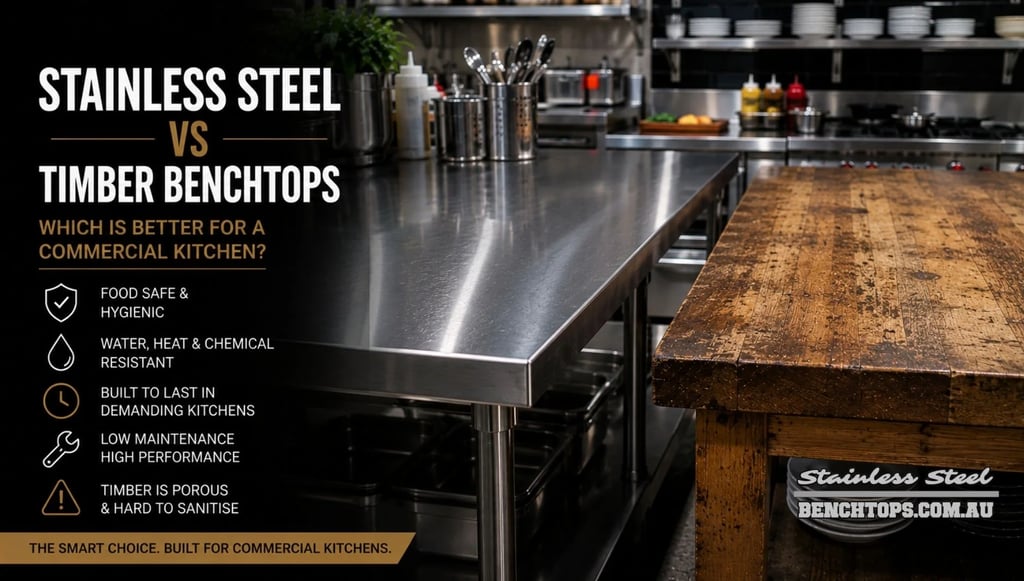
The stainless steel vs timber decision in a commercial kitchen isn't really a close debate: stainless steel is the food-safe, compliance-ready, lower-maintenance material that Australian food safety standards point to, and timber simply doesn't meet the bar for a food contact surface in a licensed premises.
The real decision is which stainless bench specification suits your kitchen. For moderate commercial use, the Prosumer Premium 304-grade range is the starting point. For full-service commercial kitchens, high-volume prep and wet zone applications, the Heavy Duty Commercial Range is the correct specification. Browse the full range of stainless steel benchtops and equipment to compare sizes and configurations, or call 0403 741 781 - seven days a week - to talk through what your setup actually needs.
Get Trade Deals and Clearance Alerts
No spam, just occasional deals, new arrivals, and restock updates.


Unsubscribe anytime.
Buy Now Pay Later
Why Us?
100% Satisfaction Guaranteed On All Orders
Free Metro Delivery
Australian Support
Secure Checkout (Card or PayPal)


© 2026 StainlessSteelBenchtops.com.au. All rights reserved.